Artificial intelligence is rapidly becoming part of the hospitality industry’s operating environment.
Hotels are exploring AI applications in revenue management, guest communications, marketing, financial reporting, forecasting, and operational planning.
For hospitality executives, the conversation is moving beyond whether artificial intelligence will affect their businesses.
The more important question is how organizations will use it effectively.
And that raises another question:
Are hospitality companies recruiting and developing executives with the leadership capabilities required for an increasingly AI-enabled industry?
AI Adoption Is Moving Faster Than Organizational Strategy
A study released in October 2026 by hospitality technology consultancy h2c provides an interesting perspective.
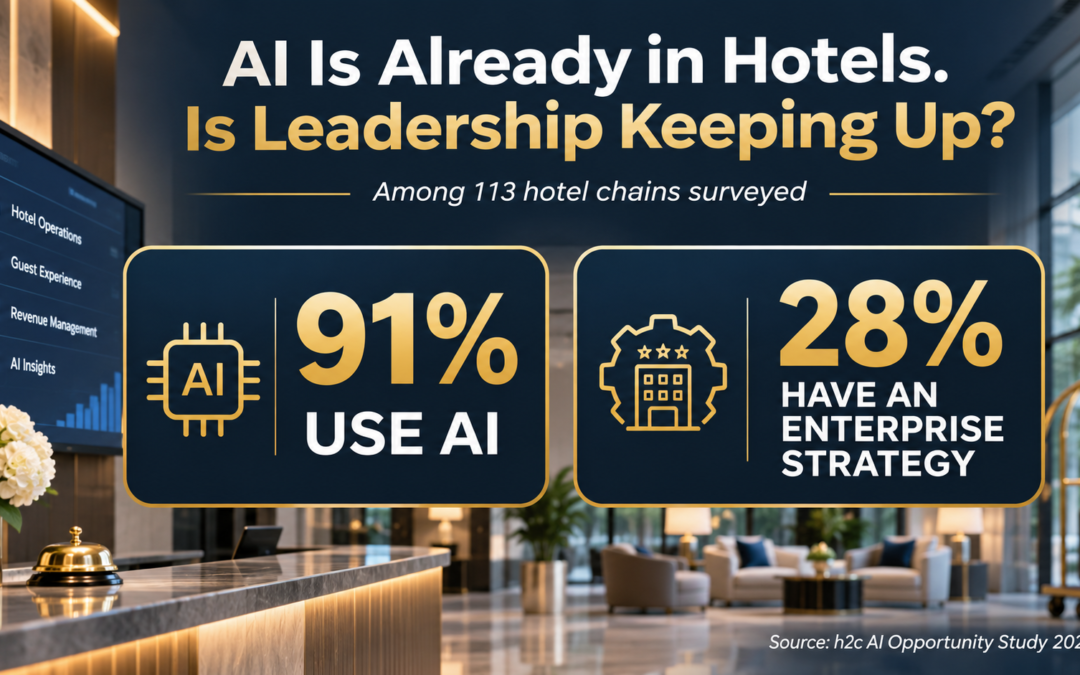
Its AI Opportunity Study 2026 examined responses from 113 hotel chains operating across multiple global regions.
The research found that 91% of participating hotel chains were already using artificial intelligence.
However, only 28% reported having an enterprise-wide AI strategy led by senior leadership.
The study also found that just 13% reported measurable return on investment from AI at that point.
These results reflect the participating hotel chains rather than the entire hospitality industry, but they highlight an important challenge.
Organizations may be adopting technology faster than they are developing the structures, skills, and leadership strategies needed to use it effectively.
Source: h2c AI Opportunity Study 2026
Technology Implementation Is a Leadership Responsibility
Installing new technology is one thing.
Successfully integrating that technology into an organization’s daily operations is another.
Consider a hotel group introducing AI-supported revenue forecasting.
The technology may help analyze historical performance, demand patterns, booking activity, and other relevant information.
But someone still needs to determine how those insights fit into the organization’s broader commercial strategy.
The same principle applies to guest communications, workforce scheduling, financial reporting, and other operational functions.
Technology may provide information and recommendations.
Executives remain responsible for evaluating those recommendations, understanding their limitations, and making decisions that support the organization’s objectives.
That requires judgment, accountability, and the ability to lead organizational change.
The Skills Hospitality Executives Will Need
Historically, many hospitality leadership positions have emphasized operational experience, financial performance, service quality, and employee management.
Those qualifications remain important.
However, as AI becomes more integrated into hotel operations, executive leadership requirements may expand.
A successful hotel General Manager may increasingly need to understand how technology affects staffing, guest service, operational efficiency, and financial performance.
A Chief Information Officer may need to demonstrate stronger capabilities in data governance, system integration, cybersecurity, and organizational collaboration.
Revenue and marketing executives may need to evaluate increasingly sophisticated forecasting and personalization tools.
Human resources leaders may be asked to help employees adapt to changing responsibilities while maintaining morale, professional development, and organizational culture.
Not every executive needs to become a technology specialist.
But senior leaders should understand how emerging technology affects their departments, their employees, and their customers.
The Human Element Remains Essential
Hospitality has always been a people-centered industry.
Guests remember how they were treated.
Employees respond to the quality of their leadership.
And organizations depend on trust, communication, accountability, and sound decision-making.
AI may help automate repetitive tasks or improve access to information.
But the ability to motivate a team, resolve a difficult guest situation, or lead an organization through uncertainty remains a distinctly human responsibility.
There is also a practical consideration.
Not every guest wants the same level of technology.
Some appreciate automated service and digital convenience. Others place greater value on personal interaction.
Effective hospitality leadership requires understanding those differences and designing service experiences accordingly.
The objective should not be automation for its own sake.
It should be improving the experience of guests and employees while supporting the organization’s financial and operational goals.
What This Means for Executive Recruitment
As technology changes, executive search criteria should evolve alongside it.
Hospitality organizations may benefit from evaluating candidates across several dimensions.
Operational expertise: Does the candidate understand the fundamentals of the business?
Technology judgment: Can the candidate distinguish useful innovation from technology that adds unnecessary complexity?
Change management: Can the executive help employees adapt to new processes and responsibilities?
Financial discipline: Can they evaluate technology investments against measurable business objectives?
People leadership: Can they maintain a strong organizational culture while introducing new systems?
These capabilities should complement—not replace—the traditional qualifications associated with successful hospitality executives.
The Importance of Asking Better Interview Questions
For employers recruiting senior hospitality leadership, the changing environment creates an opportunity to rethink portions of the interview process.
Instead of asking only whether a candidate has experience with particular technology platforms, organizations might explore how the executive has approached technological change.
How did they evaluate a proposed investment?
How did they involve employees in the implementation process?
What measurable outcomes were achieved?
What did they learn when an initiative failed to meet expectations?
How did they balance efficiency with service quality?
These questions can provide greater insight into a candidate’s leadership judgment than a simple list of software platforms on a résumé.
The Next Generation of Hospitality Leadership
Artificial intelligence will continue to influence how hospitality organizations operate.
Some applications will deliver meaningful improvements. Others may prove less useful than initially anticipated.
The executives best positioned to navigate these changes will likely be those who combine operational knowledge, financial discipline, technological awareness, and strong people-management skills.
For hotel owners, casino resort operators, and hospitality organizations, the implication is clear.
The future of hospitality leadership will not be determined by technology alone. It will depend on the people responsible for using it wisely.
And identifying those people should remain a central consideration in executive recruitment.
Bentley Price Associates specializes in executive search throughout hospitality and casino gaming and is celebrating its 50th anniversary in 2026.