By Dennis Rizzo & John Elliott
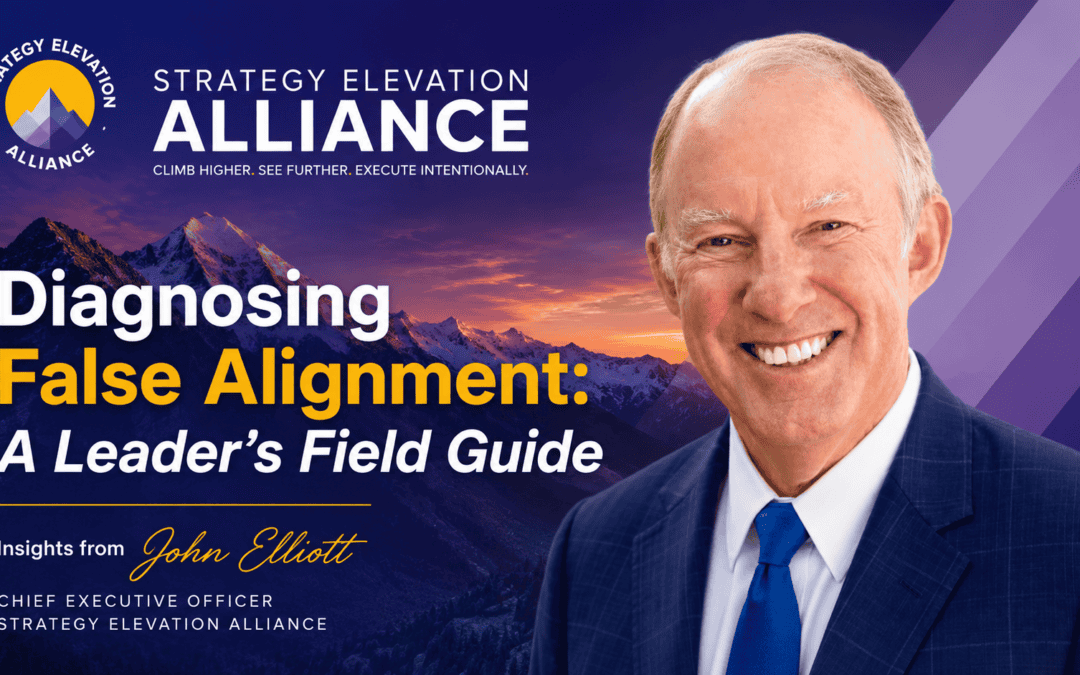
In our last conversation, John Elliott of Strategy Elevation Alliance shared something that has stayed with me: organizations often believe their leadership teams are aligned simply because everyone agrees during meetings. Yet the results tell a different story.
This raised an obvious follow-up question. If alignment isn’t the same as agreement, how does a leader actually know the difference?
I sat down with John again to dig deeper into this question, and what emerged was less a checklist than a way of listening, a set of signals that experienced leaders learn to notice long before a quarterly report confirms what they already suspected.
The Meeting That Feels Fine Isn’t Always Fine
John has sat in on hundreds of leadership meetings across gaming, hospitality, tribal and other enterprises. He says the most dangerous meetings are not the contentious ones. They’re the smooth ones.
“When everyone nods and no one pushes back, that’s not consensus,” John told me. “That’s often silence wearing consensus as a disguise.”
He’s learned to watch for a particular pattern: a leader raises an initiative, heads nod around the table, and the meeting ends on schedule. Then, twenty minutes later, the real conversation starts, in the hallway, over coffee, in a side channel on Slack. That’s where the honest opinions live.
“If the real meeting happens after the meeting,” John says, “you don’t have alignment. You have politeness.”
Five Signals Worth Watching
Over the course of our conversation, John walked me through the signals he relies on most. They simply require a leader willing to pay close attention listen and observe.
Silence in the room. Not everyone needs to speak in every meeting, but if certain voices never challenge a plan ,ever, that’s worth noticing. Genuine alignment includes disagreement. It just resolves it before people leave the room.
Delayed dissent. When concerns surface after a decision has been made rather than before, it’s a sign people didn’t feel safe raising them earlier. By the time the objection arrives, it often arrives as resistance instead of input.
Inconsistent language. John pays close attention to how leaders describe the same priority. If five executives describe “our top priority this quarter” five different ways, alignment is thinner than it appears on paper.
Metrics that quietly miss. One missed target might be circumstance. A pattern of near misses across multiple leaders, John says, is usually a structural issue, not a performance issue.
Trust measured in defensiveness. When feedback is met with explanation rather than curiosity, John sees it as an early warning. “Aligned teams ask, ‘help me understand that differently,’” he said. “Misaligned teams ask ‘why are you saying that.’”
Why This Matters More Than It Seems
It would be easy to treat these signals as soft, interpersonal concerns, important but secondary to strategy and execution. John pushed back firmly on that framing.
“These aren’t culture problems sitting next to your execution problems,” he said. “They are your execution problems. They just haven’t shown up in the numbers yet.”
This is consistent with something John emphasized in our earlier conversation: alignment exists when leaders share a common understanding of priorities, challenge each other productively, and remain committed to decisions after they leave the room. Each of the five signals above is simply a way of testing whether that’s actually happening, or whether it only appears to be happening.
What Leaders Can Do About It
I asked John what a leader should do once they notice these signals. His answer was refreshingly unbureaucratic.
Start with a single question, asked directly: “Where do we actually disagree?” Not in a survey. Not in an anonymous form. In the room, out loud. Use statements that require a degree of acceptance or non-acceptance.
John has found that simply naming the pattern “I’ve noticed we tend to agree quickly and then hear concerns afterward, and I want to change that”, is often enough to shift how a team behaves in the very next meeting.
“People aren’t avoiding honesty because they’re dishonest,” he said. “They’re avoiding it because no one has made it clearly safe. Leaders create that safety by going first.”
Explain with clarity how decisions are made by using a framework such as RAPID.
He also cautioned against overcorrecting into process. Adding a new committee, a new survey tool, or a new round of meetings to “measure alignment” often creates the appearance of accountability without the substance of it. The goal, as John put it, is not more structure. It’s more honesty inside the structure that already exists.
The Bigger Picture
Toward the end of our conversation, John returned to a theme he raised previously: that leadership is ultimately an affair of the heart. Diagnosing false alignment, he said, is really about courage, the courage to ask a question you might not want the answer to, and the discipline to listen without defending.
“Boards and CEOs often want a dashboard for this,” John said. “But the truth is, you already have the dashboard. It’s the conversation you’ve been avoiding.”
For organizations navigating executive transitions, market disruption, or simply the everyday complexity of running a gaming, hospitality, or tribal enterprise, that may be the most valuable diagnostic tool of all,not a new system, but a willingness to notice what’s already being said, and what isn’t as Culture Eats Strategy for Breakfast.